
My topic
Inspiring students’ motivation from mobile edutainment
Introduction of my topic
The fact that almost every student has a smartphone makes it an ordinary thing to regard it as a learning tool. Also, the learners’ interaction with the learning materials can take place anytime, anywhere in diverse learning contexts (Giannakas, Kambourakis, Papasalouros, & Gritzalis, 2018). More importantly, the combination of entertainment with learning makes it a huge attraction. People do benefit a lot from the variety of applications available on their phones. Therefore, it is worth discussing in which aspects the mobile learning (m-learning) can attract students’ attention, and how to make mobile edutainment inspire students’ learning motivation properly and effectively.
My special topic is mainly about how to use mobile devices to develop students’ interest in learning and stimulate their internal motivation while providing students with a relaxing and meaningful learning environment and a better learning process (Zacarias, Cuapa, & Hernández, 2009) in order to improve their learning efficiency and quality, in which three keywords can be extracted: mobile, edutainment and inspiring motivation. The first keyword is “mobile”. In other words, the use of smartphones in learning will be mainly discussed in my special topic. It also involves other mobile devices, such as tablets and laptops. The second keyword is “edutainment”. It is a special field of educational technology, combining entertainment with education. Currently, common mobile edutainment technologies and platforms include game-based learning, animation, mobile learning programs and applications, augmented reality (AR) technology, etc.. The last one is about the aim of this research. Learning motivation is the starting point for learning and edutainment brings out learning motivation. Based on constructivism, students should be the center of learning activities. Therefore, they should be spontaneous and active users of m-learning technologies, rather than just observers and receivers. The development of technology does not simply allow students to have a more pleasant experience, but to feel an attraction for learning from pleasure. That is to say, in order to maintain the lasting enthusiasm for learning and maximize the learning effect it is necessary to maintain a reasonable balance between education and entertainment.
Mobile learning can take place in the classroom and out of class (Sandberg, Maris, & Geus, 2011). This research will respond to the advantages and disadvantages of mobile edutainment in these two situations, and the solutions to the problems will also be available from two aspects. That is, at the technical level there is a need for the improvement in the games and other learning applications on smartphones to make them more attractive and effective. At the same time, what really matters is the way how mobile edutainment technologies would be used and teachers’ and students’ growing competence for making edutainment technologies as useful as they are. Here, I suppose with the help of the new technologies teachers could provide students with more autonomy, that is, more time and space to learn and do things by themselves. Only in this way can students be truly motivated to learn on their own initiatives avoiding only being attracted by the entertaining features of m-learning.
References:
Giannakas, F., Kambourakis, G., Papasalouros, A., & Gritzalis, S. (2018). A critical review of 13 years of mobile game-based learning. Education Technology Research Development, 2(66), 341-384.
Sandberg, J., Maris, M., & Geus, K. (2011). Mobile English learning: An evidence-based study with fifth graders. Computers and Education, 1(57), 1334-1347.
Zacarias, F., Cuapa, R., &Hernández, F. (Eds.). (2009). Proceedings from MoMM’09 : Proceedings of the 7th International Conference on Advances in Mobile Computing and Multimedia. ACM, NY: New York.
List of resources
- Chaudhary, A. G. (2010). Mobile Gaming: A New Platform for Edutainment in India. Journal of Creative Communications, 5(2), 119–129.
- Giannakas, F., Kambourakis, G., Papasalouros, A., & Gritzalis, S. (2018). A critical review of 13 years of mobile game-based learning. Education Technology Research Development, 2(66), 341-384.
- Anuar, M. Y., Esther, G. S., Daniel, W. L., & Kamarulzaman, A. A. (2014). Teachers’ perception of mobile edutainment for special needs learners: the Malaysian case. International Journal of Inclusive Education, 18(12), 1237-1246.
- Zacarias, F., Cuapa, R., & Hernández, F. (Eds.). (2009). Learning English in an authentic mobile environment. Proceedings from MoMM’09: Proceedings of the7th International Conference on Advances in Mobile Computing and Multimedia. ACM, NY: New York.
- Sandberg, J., Maris, M., & Geus, K. (2011). Mobile English learning: An evidence-based study with fifth graders. Computers and Education, 1(57), 1334-1347.
- Putra, W. D. P., & Setyaningrum, W. (2018). The effect of edutainment toward students’ interest in learning mathematics. Journal of physics,1097, 121-127.
- Ariel, Y., & Elishar-Malka, V. (2019). Learning in the smartphone era Viewpoints and perceptions on both sides of the lectern. Education and Information Technologies, 1(18), 1-12.
Annotated bibliography
Annotated bibliography 1
This article studies mobile games in the context of India. First, Chaudhary (2012) describes the current situation of the Indian gaming industry, especially the increasing market share of the mobile game industry. The article was published in 2012 when communication was still in the 3G stage. Nowadays, 4G has been popularized, and the era of 5G has come. Under such a background, the nature of edutainment from mobile phones will be more and more obvious.
The author mainly focuses on the influence of mobile games and mobile learning programs, which are the two main mobile edutainment platforms discussed in my paper. They can not only benefit many people in learning by playing with great pleasure, but also have a deeper impact, which can improve people’s cultural level, reduce the poverty of rural population and narrow the gap between urban and rural areas.
The importance of mobile games is self-evident. While bringing people joy, it can provide a real-time and convenient learning environment, as well as high quality and low-cost learning experience.
Reference
Chaudhary, A. G. (2010). Mobile Gaming: A New Platform for Edutainment in India. Journal of Creative Communications, 5(2), 119–129.
Annotated bibliography 2
Based on the interviews with teachers from a variety of schools in Malaysia, the authors their views of mobile edutainment with aspect to special education. This article makes an investigation and in-depth analysis of the current situation of mobile learning and special needs learners. It is emphatically pointed out that though there are some obvious advantages of mobile learning when it is applied to special education, the positive effects are being questioned. Actually, for special needs learners with ADHD or autism, there are some real obstacles for them to operate mobile devices. In order to solve this problem, some corresponding solutions can be introduced such as the teacher training and equipment improvement for the special groups.
The analysis in this paper indeed reveals the application of mobile learning in an area with little concern and broaden my field of study, while it lacks the elaboration on how mobile technology can be used as a teaching tool.
Reference
Anuar, M. Y., Esther, G. S., Daniel, W. L., & Kamarulzaman, A. A. (2014) Teachers’ perception of mobile edutainment for special needs learners: the Malaysian case. International Journal of Inclusive Education, 18(12), 1237-1246.
Annotated bibliography 3
This article shows sufficient data on English learning using mobile phones, and also looks at the combination of learning with entertainment. Although it was published early and many ideas are behind the times, the explanation of English learning methods in this article is still very practical. The two most important aspects of learning English are speaking and listening. It is undeniable that one can grasp a language very well only with the help of radio and tape. Many people can’t learn English well because they can’t stick to it. One of the most important reasons is whether they are lack of motivation. The development of science and technology has brought more and more novel learning methods, which can provide learners a variety of stimuli, and stimulate learners’ interest and curiosity. Therefore, contemporary language learners are lucky as we have much more chances to have greater enthusiasm for learning.
Reference
Zacarias, F., Cuapa, R., & Hernández, F. (Eds.). (2009). Learning English in an authentic mobile environment. Proceedings from MoMM’09: Proceedings of the 7th International Conference on Advances in Mobile Computing and Multimedia. ACM, NY: New York.
Literature map
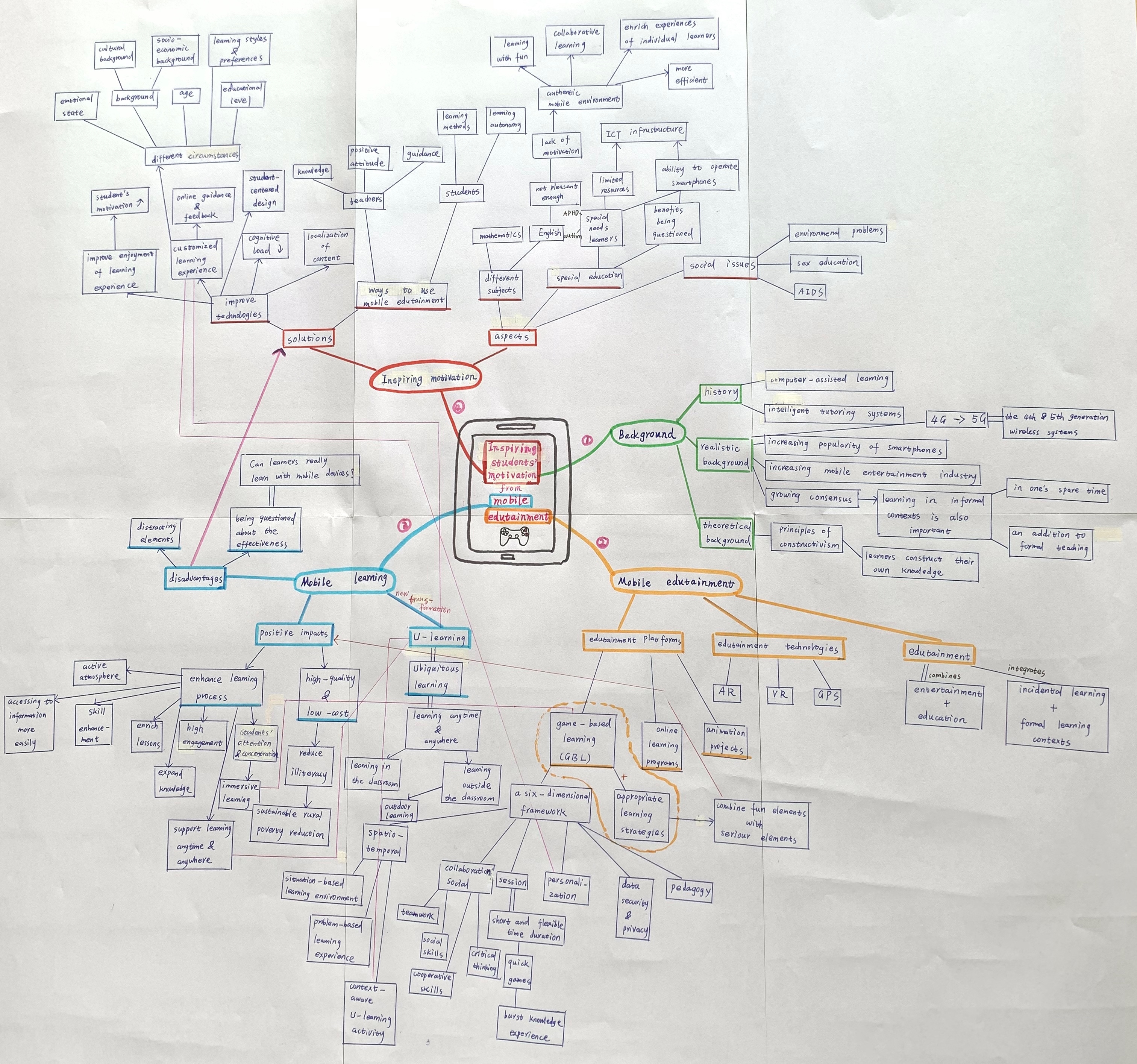
Explanatory text for the literature map
This literature map attempts to show how to inspire students’ motivation from mobile edutainment based on seven sources. In view of the fact that few contributions do researches from this aspect, the literature about this topic would be divided into four main themes: the background, mobile edutainment, mobile learning, and inspiring students’ motivation. As you can see, I have made connections both within or across the main themes, especially across the last three themes.
In the first part, the background of this research is summarized by integrating the sources collected online according to the topic, which can stretch down into three aspects. It’s worth noting that the theoretical background should function as the guidelines on how to solve the problems with mobile edutainment and inspire students’ motivation.
Second, under the theme of mobile edutainment, the seven articles mainly cover some edutainment platforms and technologies as well as the interpretation for the term “edutainment”.
The third part quoted with the highest frequency in the selected article is about mobile learning (m-learning), in which its positive aspects and advantages are discussed. Its new transformation ubiquitous learning (u-learning) is also elaborated.
The last part in regard to the aim of this research can be regarded as the core of this literature map. In order to figure out the problems caused by m-learning, several articles touch the solutions to inspire students’ motivation and avoid some possible distractions from the entertaining elements of mobile devices with detailed analysis from different subjects and aspects.
Details of the map
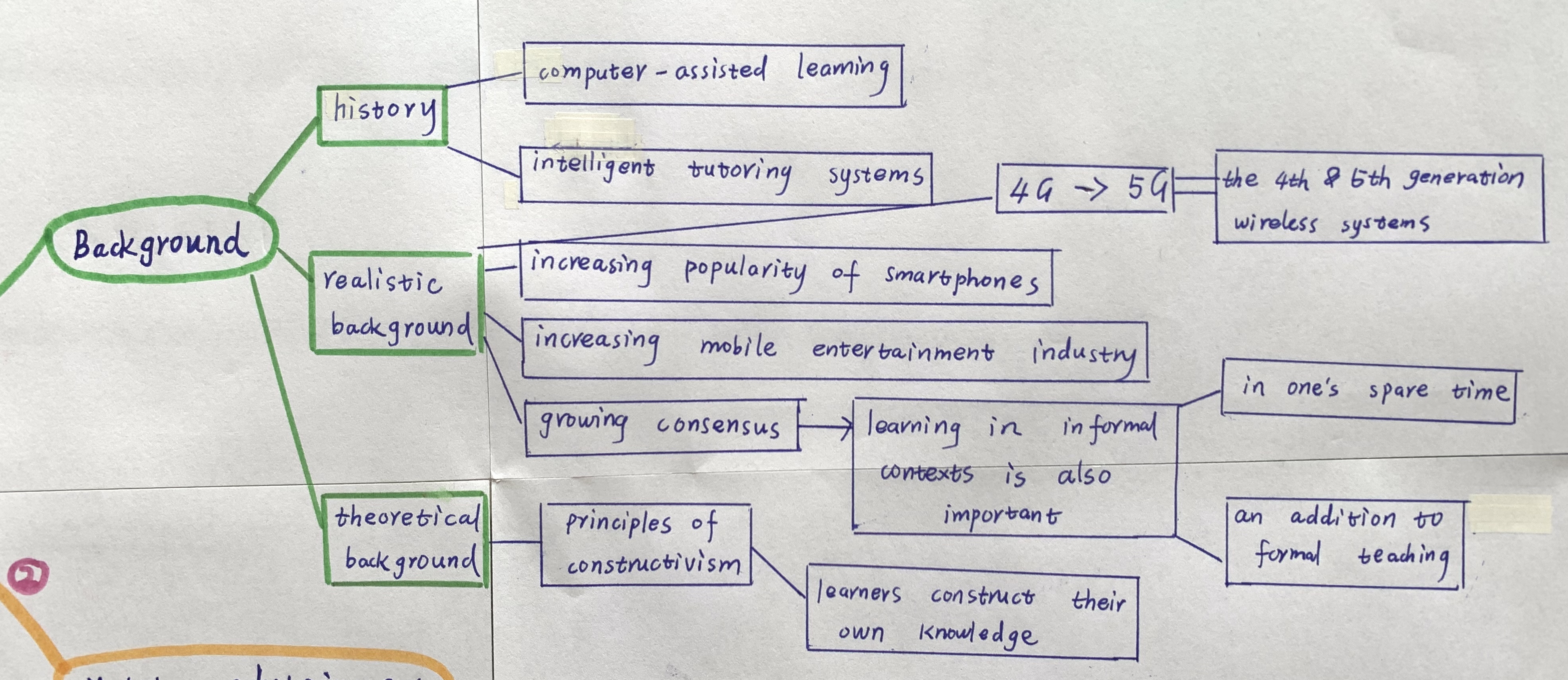
Part 1
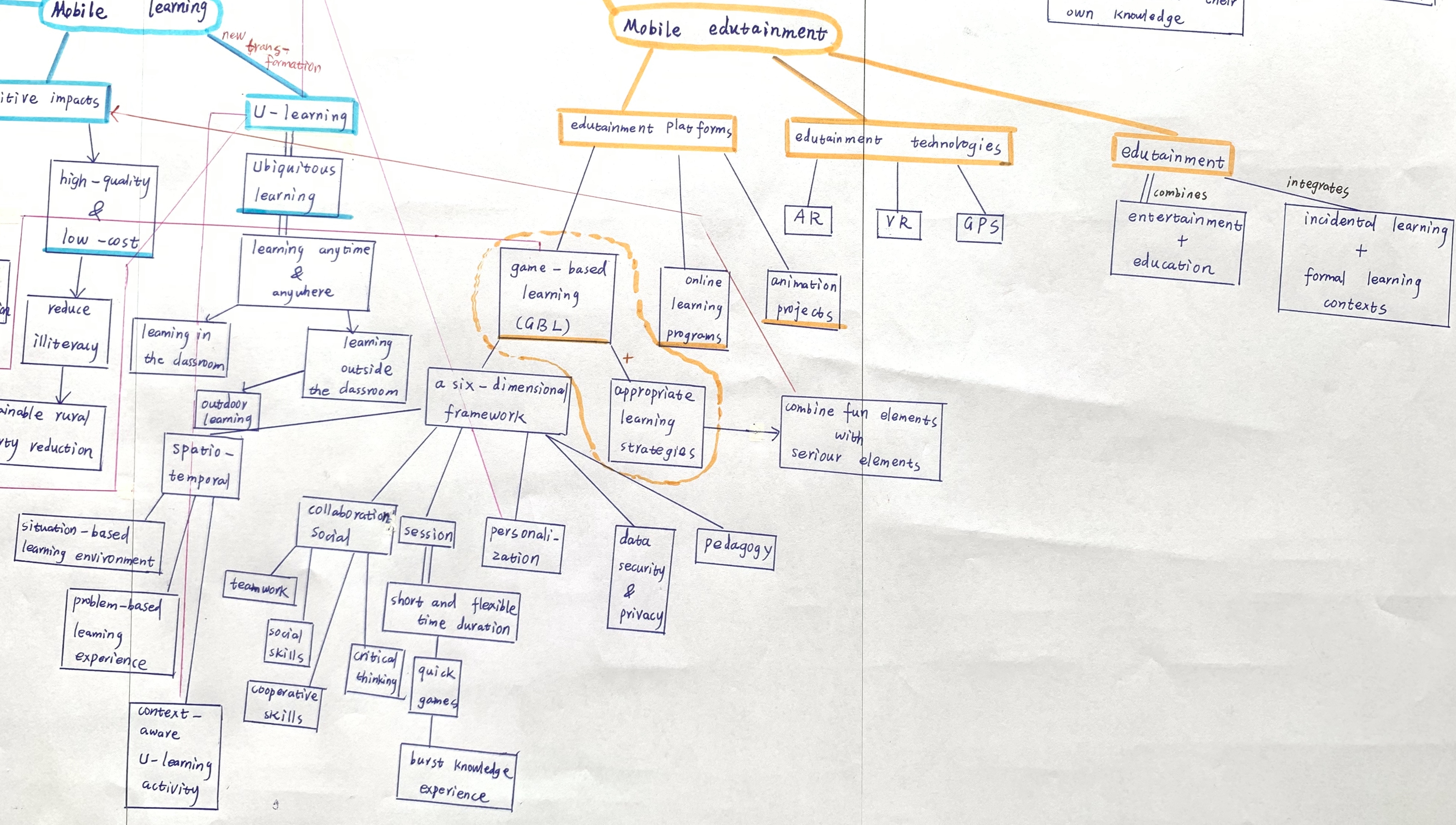
Part 2
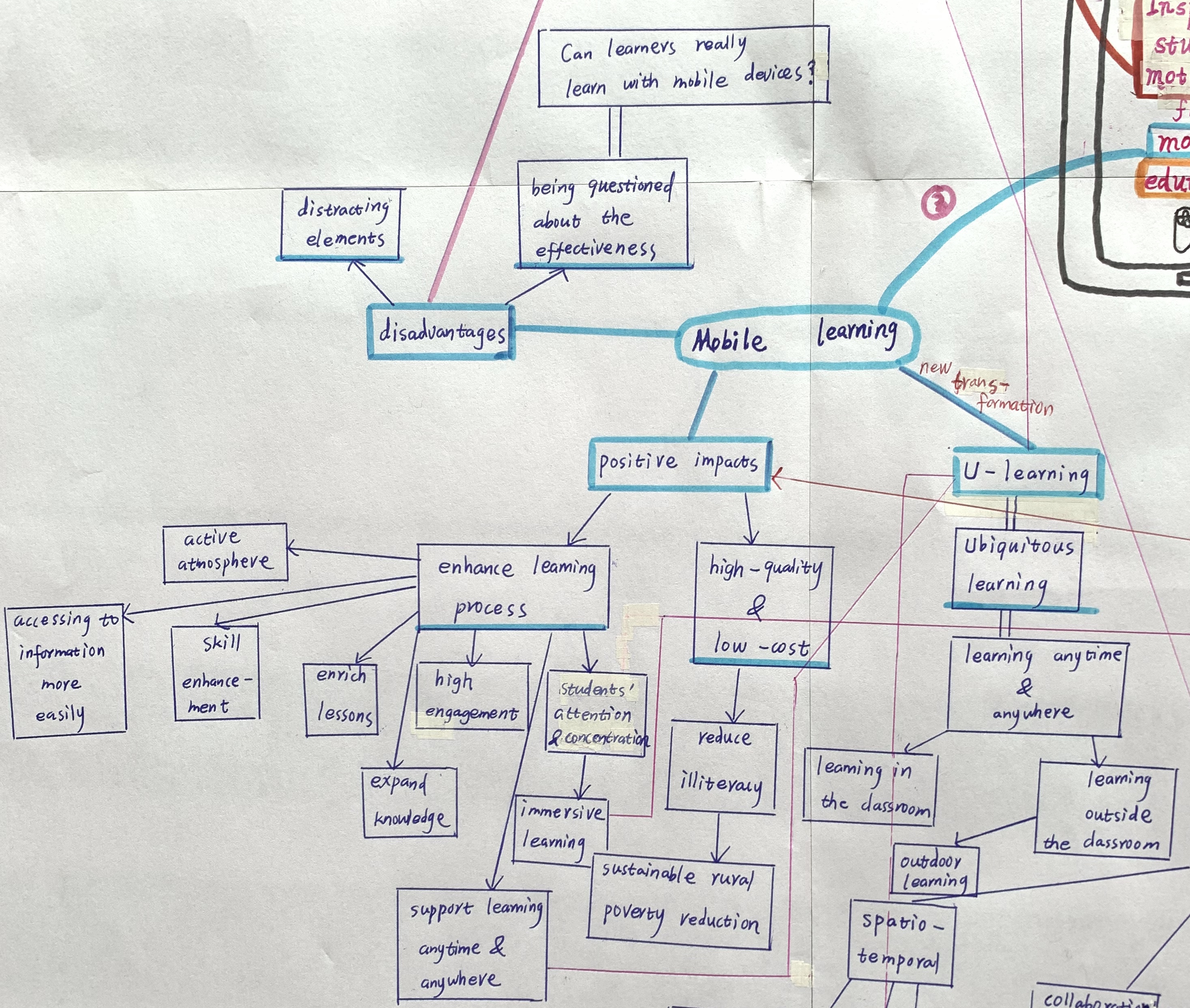
Part 3
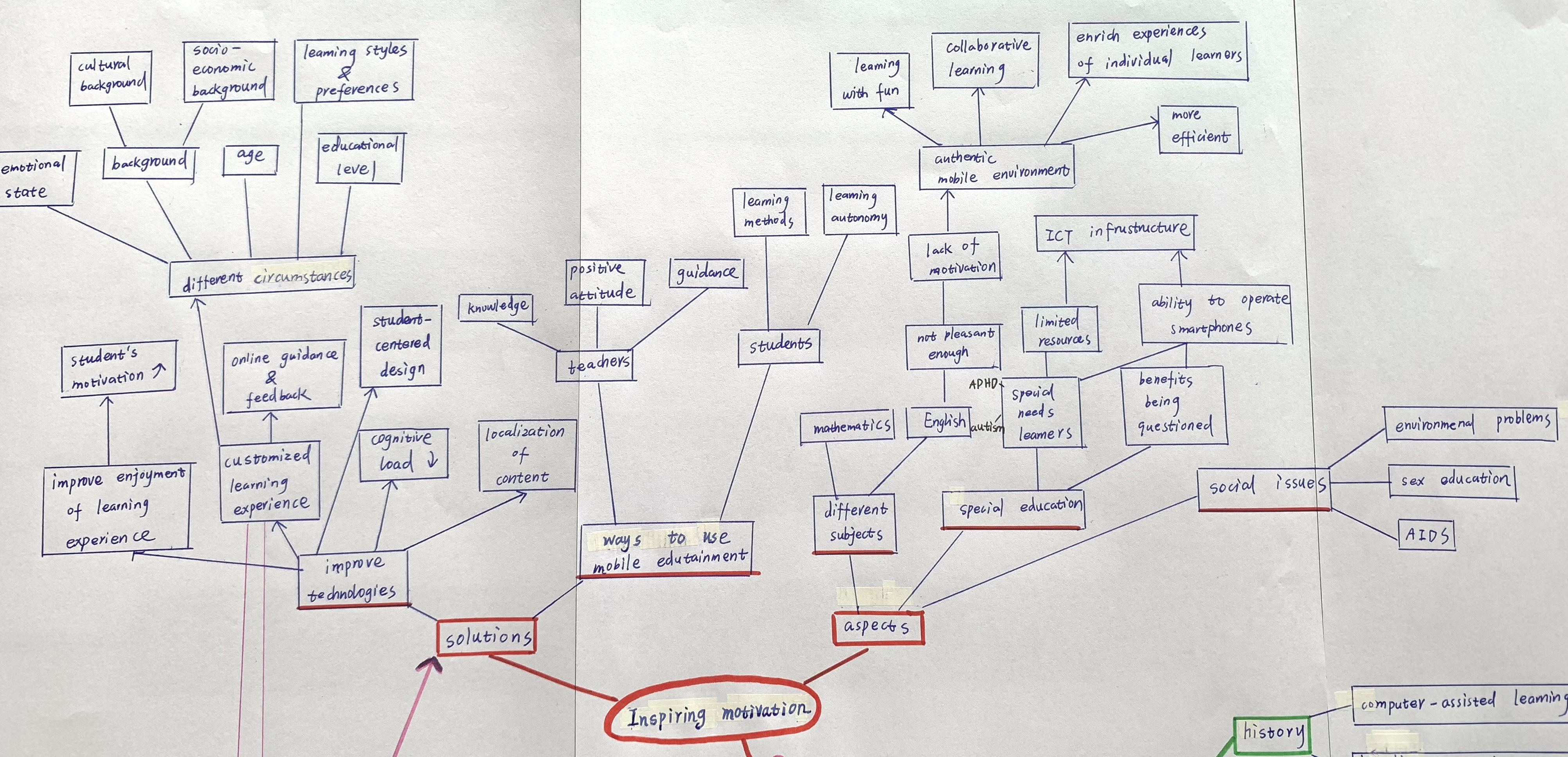
Part 4


I am interested in your topic, you give me details about how do we apply the phone into education. I hope you could give me more details about the disadvantages of the phone, and how do we face this problem,because it is a tendency that phone has a bad influence on students.
yanxi shen
赞赞